-By Chris Evans-
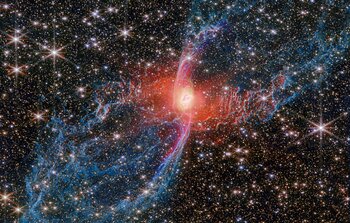
On 24 April we celebrated the 36th anniversary of Hubble’s launch, with the release of a stunning new image of the Trifid Nebula taken with WFC3. This part of the Trifid was previously observed with Hubble’s WFPC2 in 1997. Comparison of the images taken almost 30 years apart reveals the movement in the outflowing jets, serving as another great example of Hubble’s long time-baseline capabilities, when drawing on its priceless archive of multi-decade observations.
Earlier in April, in Vienna we held the latest in our series of ESA-sponsored conferences that showcase the science from Hubble and Webb, and a brief summary of the conference is here. The deadline for Cycle 34 proposals was also in mid-April, and a total of 884 proposals were received (compared to 833 in Cycle 33). Demand for Hubble’s unique observing capabilities remains as competitive as ever, with an overscription of the time available for General Observer (GO) programmes of approximately 7.5:1. Moreover, there was another excellent response from PIs in the ESA Member States, who led 23% of the submitted proposals. Cycle 34 will start on 1 November 2026, and run to 31 October 2027.
In the past month we have also had meetings at STScI of both the Space Telescope Users Committee and the JWST Users Committee, with the meeting presentations available from the respective webpages. There are three ESA-appointed representatives on each of the two committees, as listed here and here. If you, the European users of Hubble and Webb, have questions or comments that you would like to raise with either of the committees, please contact one of our representatives.
Looking ahead for Webb, the Cycle 6 timeline is available here, with the Call for Proposals to be released in late July and the submission deadline on 30 September. Let me also highlight the continuing Webb Office Hours sessions on the second and fourth Thursday of each month. This is an opportunity for JWST users to interact directly with the JWST team at STScI and to ask questions about topics such as the JWST pipeline, calibration, science instrument performance, proposal planning, excecuted observations, or any other questions you might have about your data.
The Rocky Worlds Director’s Discretionary Time (DDT) programme continues to make great progress, and details of the newly-announced Rocky Worlds Data Challenge, concluding with a workshop at STScI in November, are here.
As in our past newsletters, our outreach team will be delighted to hear from you if you have new results from your Hubble or Webb programmes that you think would be of wider public interest; please contact us at: [email protected].
Lastly, there is a new Call for Expressions of Interest for new members of ESA’s science advisory committees: the Space Science Advisory Committee (SSAC), Astronomy Working Group (AWG) and the Solar System and Exploration Working Group (SSEWG). Further details are available here.
Contact:
Chris Evans
ESA/HST & ESA/JWST Project Scientist
ESA Office, STScI Baltimore, USA
Email: [email protected]
|
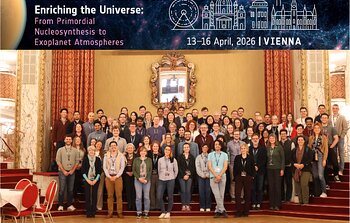
28 May 2026: Our latest in the series of ESA-sponsored conferences on the Science with the Hubble and James Webb Space Telescopes, was held on 13-16 April 2026 in Vienna, Austria. This ESA conference was organised in collaboration with STScI and the Department of Astrophysics at the University of Vienna.
The overarching science theme of the conference was the chemical evolution of the …
|
| Read more |

|
28 May 2026: - By Chris Evans -
The Rocky Worlds Director’s Discretionary Time (DDT) programme, introduced in our newsletter last June, is combining Hubble’s and Webb‘s unique capabilities for exoplanet science to search for evidence of atmospheres on rocky exoplanets in orbit around M-dwarf stars.
The programme is making excellent progress, with all Hubble and Webb data obtained for the first target …
|
| Read more |