sci26003 — Announcement
ESA Hubble & Webb Conference
28 May 2026
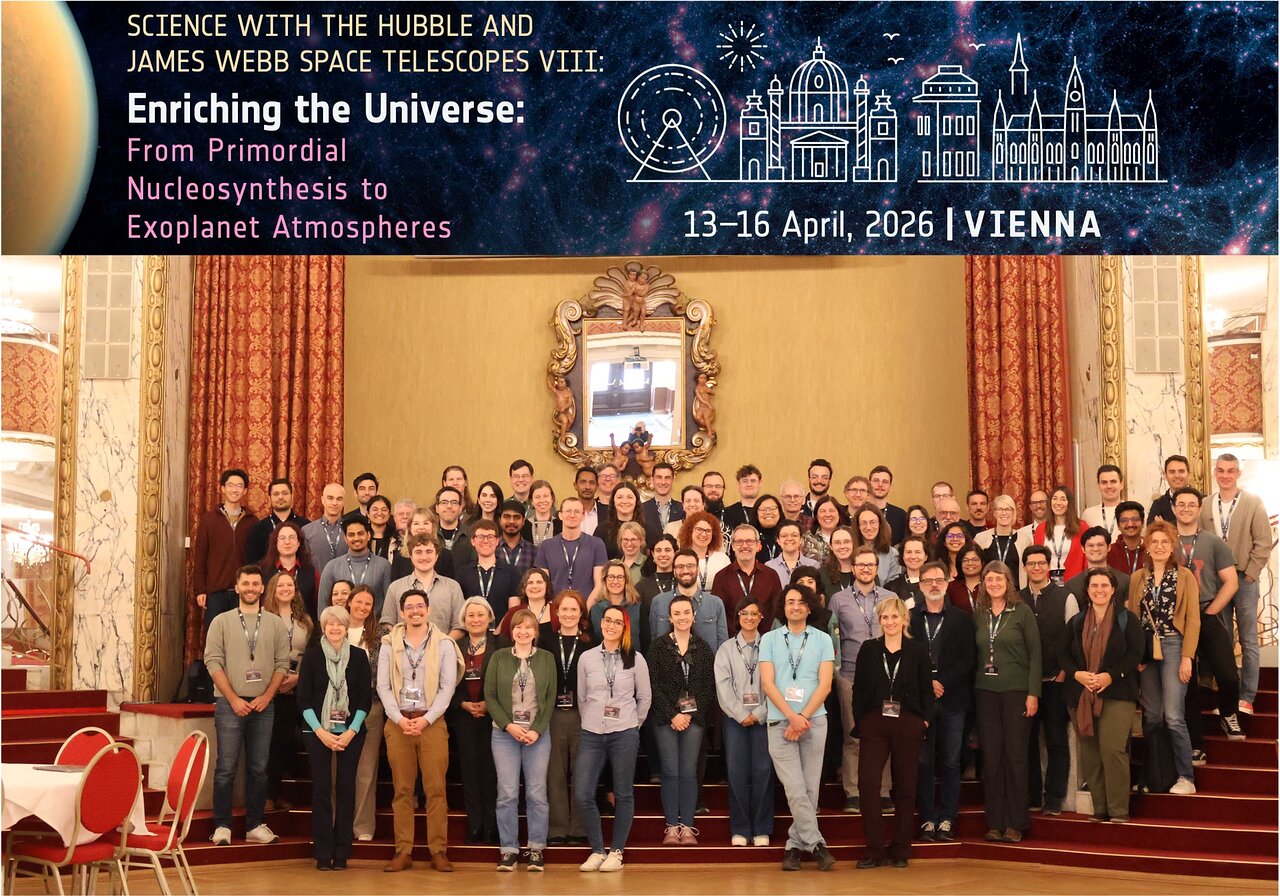
Our latest in the series of ESA-sponsored conferences on the Science with the Hubble and James Webb Space Telescopes, was held on 13-16 April 2026 in Vienna, Austria. This ESA conference was organised in collaboration with STScI and the Department of Astrophysics at the University of Vienna.
The overarching science theme of the conference was the chemical evolution of the Universe. This topic underpins a broad range of the ongoing frontier research with Hubble and Webb, including the production of heavy elements in the first stars, the chemical enrichment of galaxies over successive generations of star formation and stellar death, and the complex chemistry in the interstellar medium and stellar environments, that builds-up the molecules in exoplanet and solar system planetary atmospheres.
The scientific content of the conference was grouped in two pillars: ‘Nucleosynthesis over cosmic time’ and ‘The chemical journey from dust and ice to atmospheres.’ The science sessions within the two pillars each featured an invited talk to introduce different topics, combined with 31 contributed talks across the programmeme. The programmeme also featured 24 poster presentations, with physical posters on display throughout the week and 5-minute ‘context talks’. The context talks enabled poster presenters to introduce themselves and their work, with time also included in those sessions to view the posters and to give participants an immediate opportunity to ask questions of the presenters. The full list of talks and contributions is available from the conference page. In addition, Prof. Laura Kreidberg (MPIA) gave a public talk during the week at the Vienna Observatory, which was facilitated by Dr Maximilian Günther (ESA).
The science sessions of the week were bookended by two programmematic sessions. To set the scene on Day 1, the first session featured talks on ESA’s Science Programme and the latest on Hubble, Webb, and Roman from the STScI Mission Heads. On the final day we turned our attention to look ahead to the 2030s and beyond, with talks on the future ESA Science programme, the future ESO programme, the future prospects for Hubble, and plans for the Habitable Worlds Observatory (HWO). On Day 2 there was a dedicated session on the European HST and JWST Science Archives, which included a hands-on exercise with ESA’s DataLabs science platform. The latter featured some of the High Level Science Products (HLSPs) now available in the European archives from the Rocky Worlds DDT programmeme and the Hubble Spectroscopic Legacy Archive.
A recurring theme throughout the talks and discussions during the week was the critical contribution of Hubble’s ultraviolet and visible observations, and their complementarity with Webb and other facilities across the electromagnetic spectrum. Hubble’s capabilities will not be surpassed until a mission such as HWO is in operation. In particular, the rich diagnostics that Hubble’s ultraviolet spectroscopy provides are vital in many fields, from exoplanets to star-forming galaxies, to obtain physical information that is otherwise inaccessible. Within this landscape, Hubble’s next discoveries will set the scientific agenda for other facilities well into the 2030s.
For Webb, after many of the first spectacular results and discoveries that come with such a transformative leap in capability, the community now has an excellent grasp of the observatory’s performance and how to extract the maximum scientific return from the data. During the week, we heard many examples of where new programmes are building comprehensive samples by pushing the observatory’s capabilities, and in many cases, addressing questions that were only posed recently by the early results from the mission. As we look ahead to the fifth anniversary in December of the exquisite Ariane 5 launch, we are excited to see what Webb will discover next!
We would like to extend our sincere thanks to the members of the Scientific Organising Committee (SOC) and Local Organising Committee (LOC), who contributed to a tremendously successful, stimulating and enjoyable conference:
SOC members: Chris Evans (Chair), Angela Adamo, Sudeshna Boro Saika, Annalisa De Cia, Ylva Götberg, Maximilian Günther, Arshia Jacob, Chiaki Kobayashi, Mercedes López-Morales, Pascal Oesch, Els Peeters, Colin Snodgrass
LOC members: Paule Sonnentrucker (co-Chair), Manuel Güdel (co-Chair), Melody Easton, Vera Flasch, Maria Gunnarsson, Sherita Hanna, Oliver Herbort, Jean-Baptiste Regnard, Simon Schleich, Gwenaëlle Van Looveren, Sofia Velasco, Elizabeth Wheatley.