Fireworks of Star Formation Light Up a Galaxy

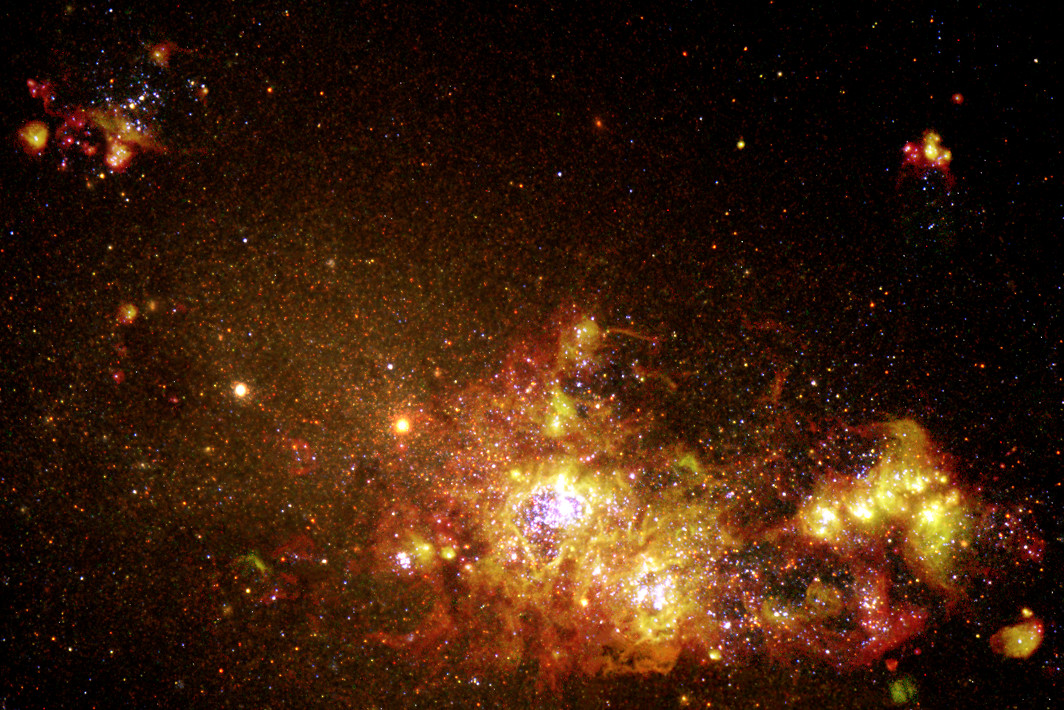
Newly released images obtained with the NASA/ESA Hubble Space Telescope in July 1997 reveal episodes of star formation that are occurring across the face of the nearby galaxy NGC 4214. Located some 13 million light-years from Earth, NGC 4214 is currently forming clusters of new stars from its interstellar gas and dust. In the Hubble image, we can see a sequence of steps in the formation and evolution of stars and star clusters. The picture was created from exposures taken in several colour filters with Hubble's Wide Field Planetary Camera 2.
About the Image
About the Object
| Name: | IRAS 12131+3636, NGC 4214, NGC 4228 |
|---|---|
| Type: | Local Universe : Galaxy : Activity : Starburst |
| Constellation: | Canes Venatici |
| Category: | Galaxies |

Classic Wallpapers



Coordinates
| Position (RA): | 12 15 38.20 |
|---|---|
| Position (Dec): | 36° 19' 29.74" |
| Field of view: | 1.75 x 1.17 arcminutes |
| Orientation: | North is 121.0° left of vertical |
View in ESASky:
View in WorldWide Telescope:

Colours & filters
| Band | Wavelength | Telescope |
|---|---|---|
| Ultraviolet U | 336 nm |
Hubble Space Telescope
WFPC2 |
| Optical OIII | 502 nm |
Hubble Space Telescope
WFPC2 |
| Optical V | 555 nm |
Hubble Space Telescope
WFPC2 |
| Optical H-alpha | 656 nm |
Hubble Space Telescope
WFPC2 |
| Optical R | 702 nm |
Hubble Space Telescope
WFPC2 |
| Infrared I | 814 nm |
Hubble Space Telescope
WFPC2 |