Long-distance relationship
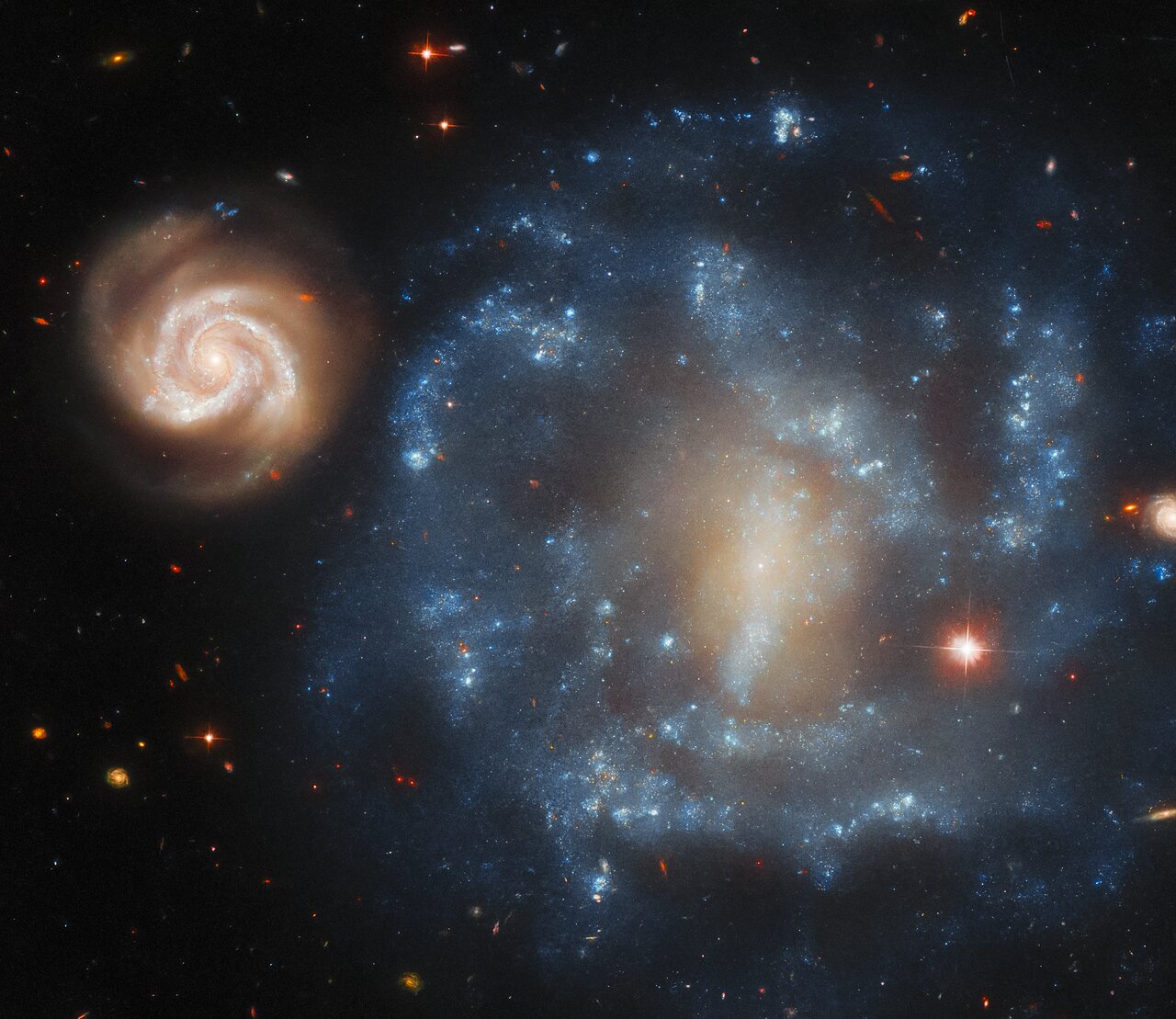
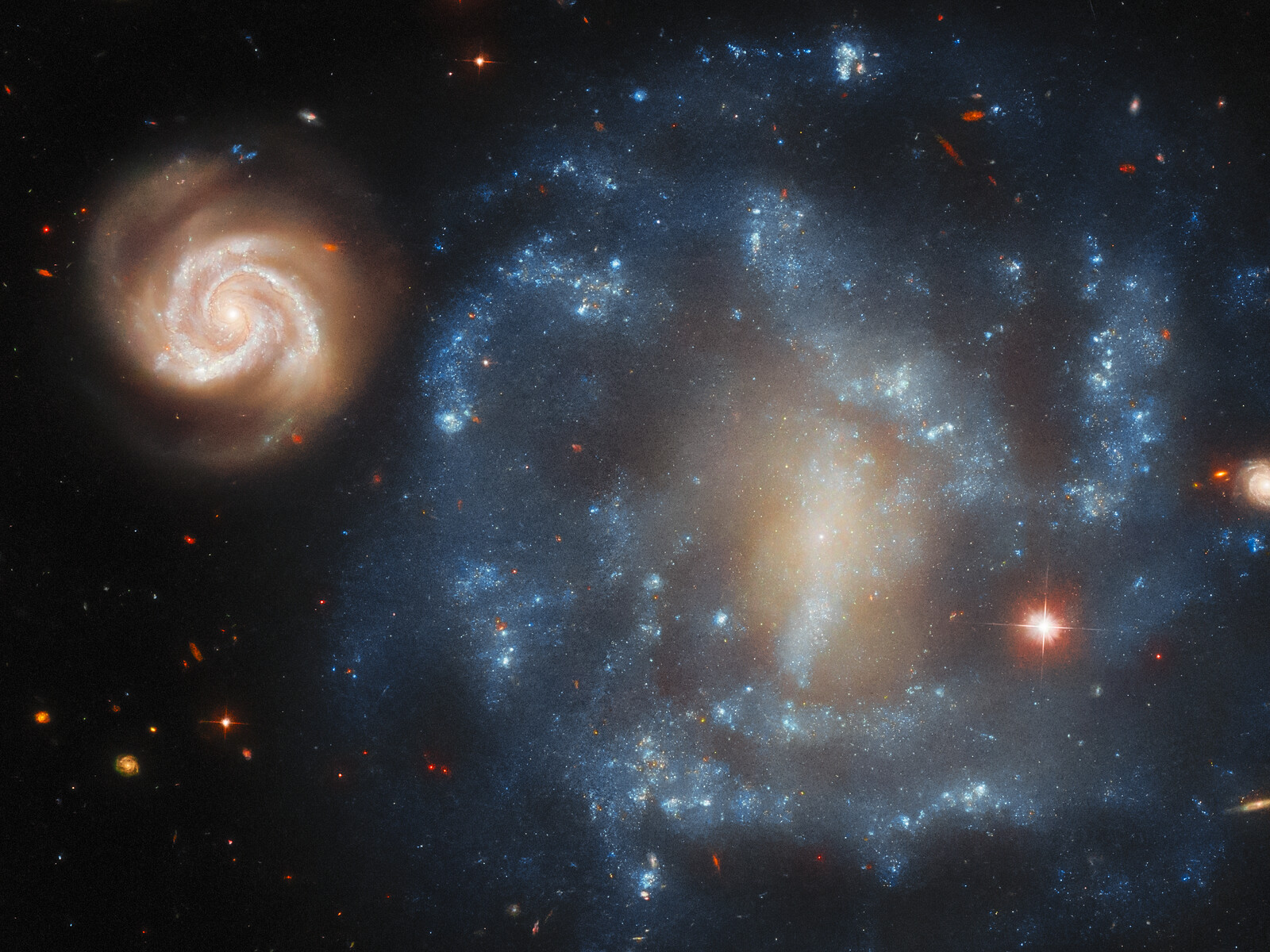
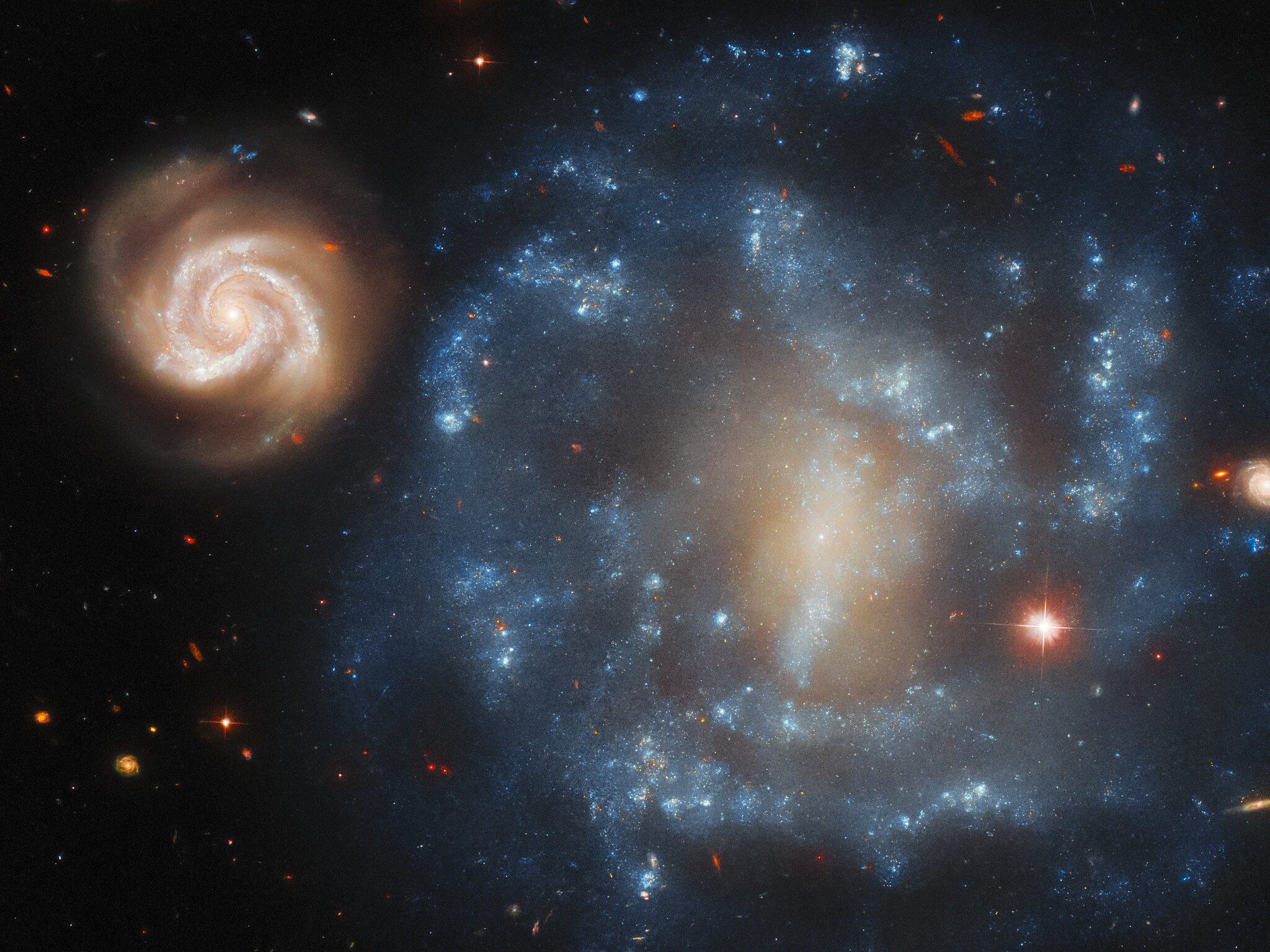
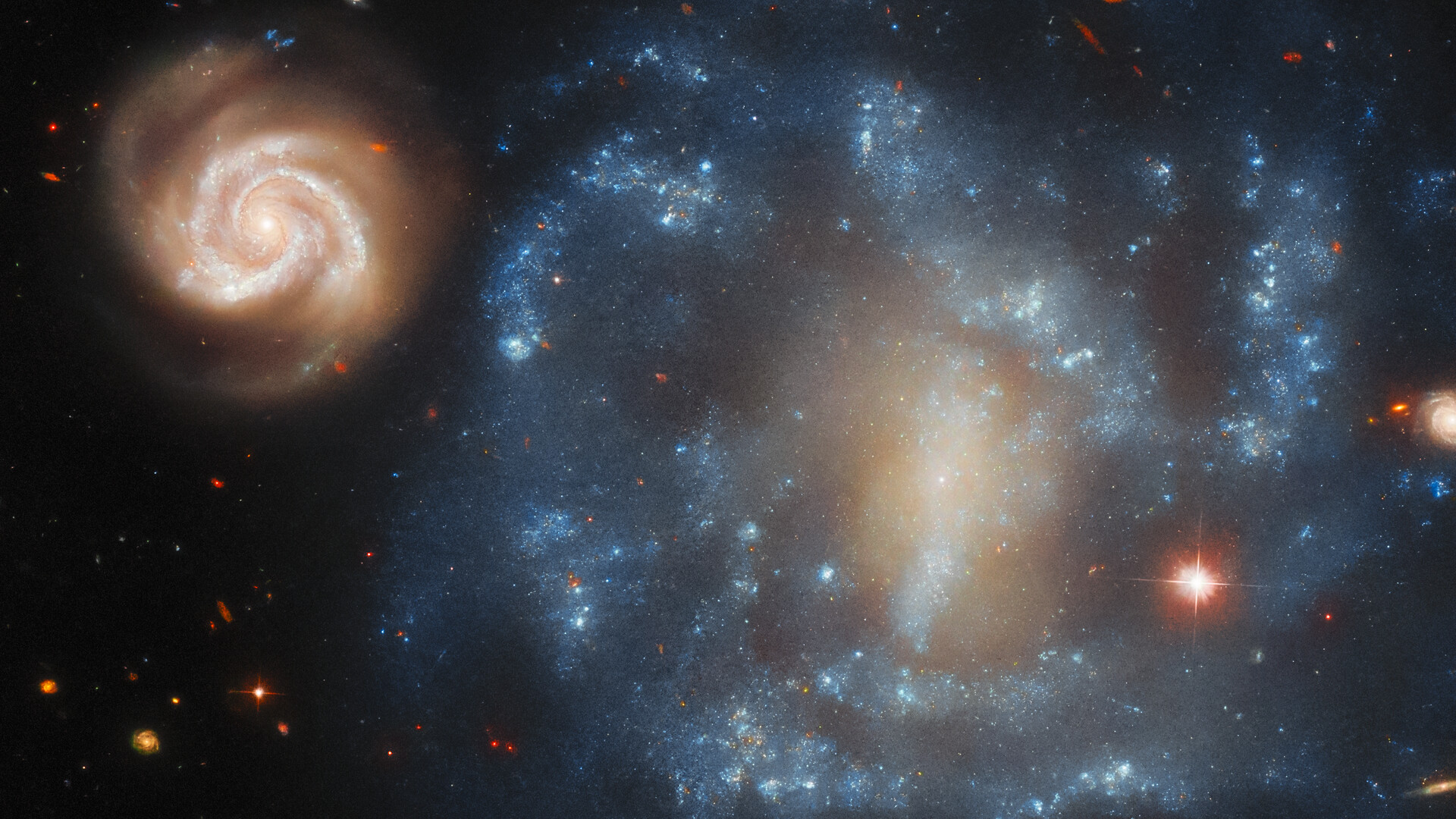
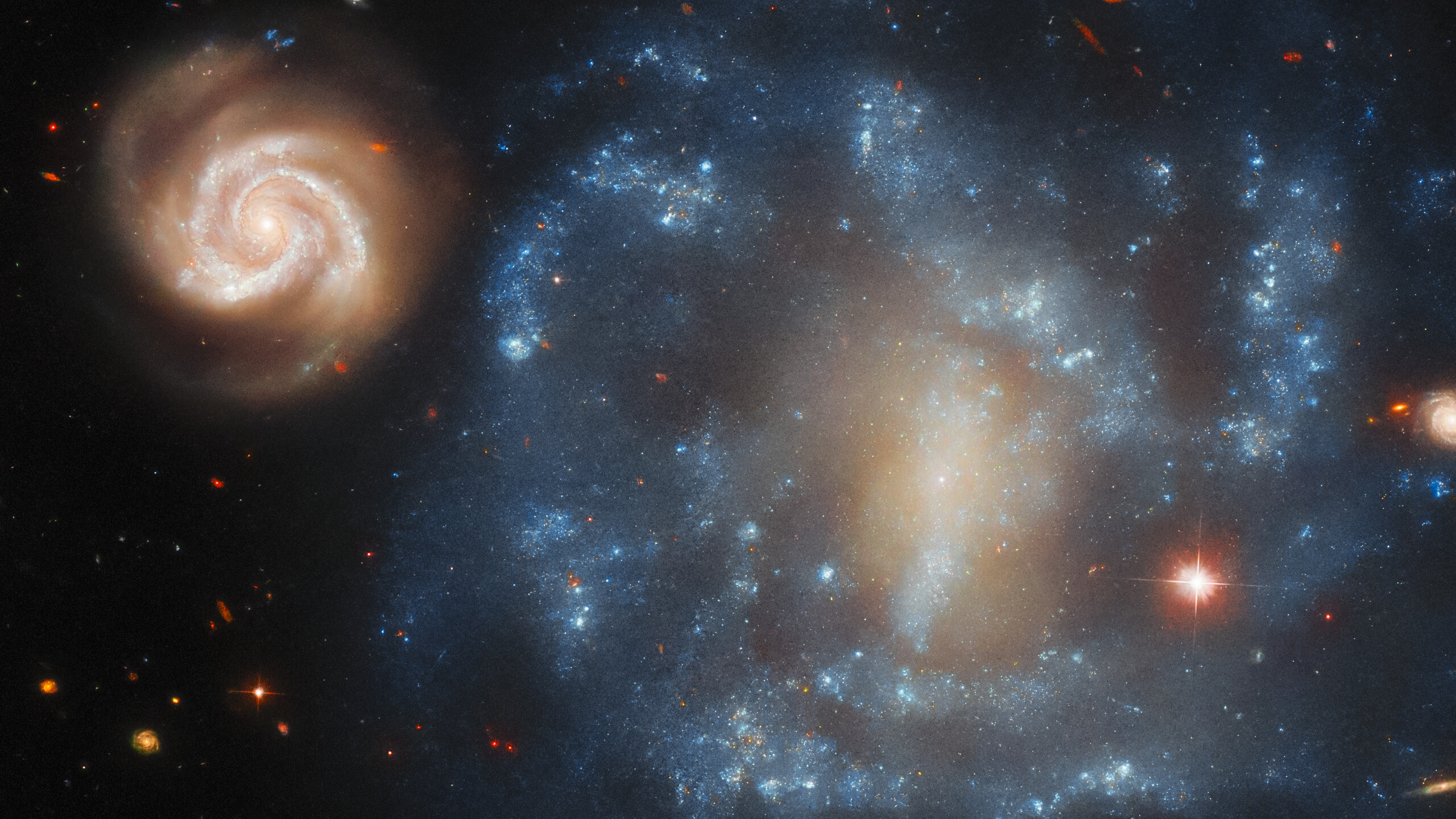
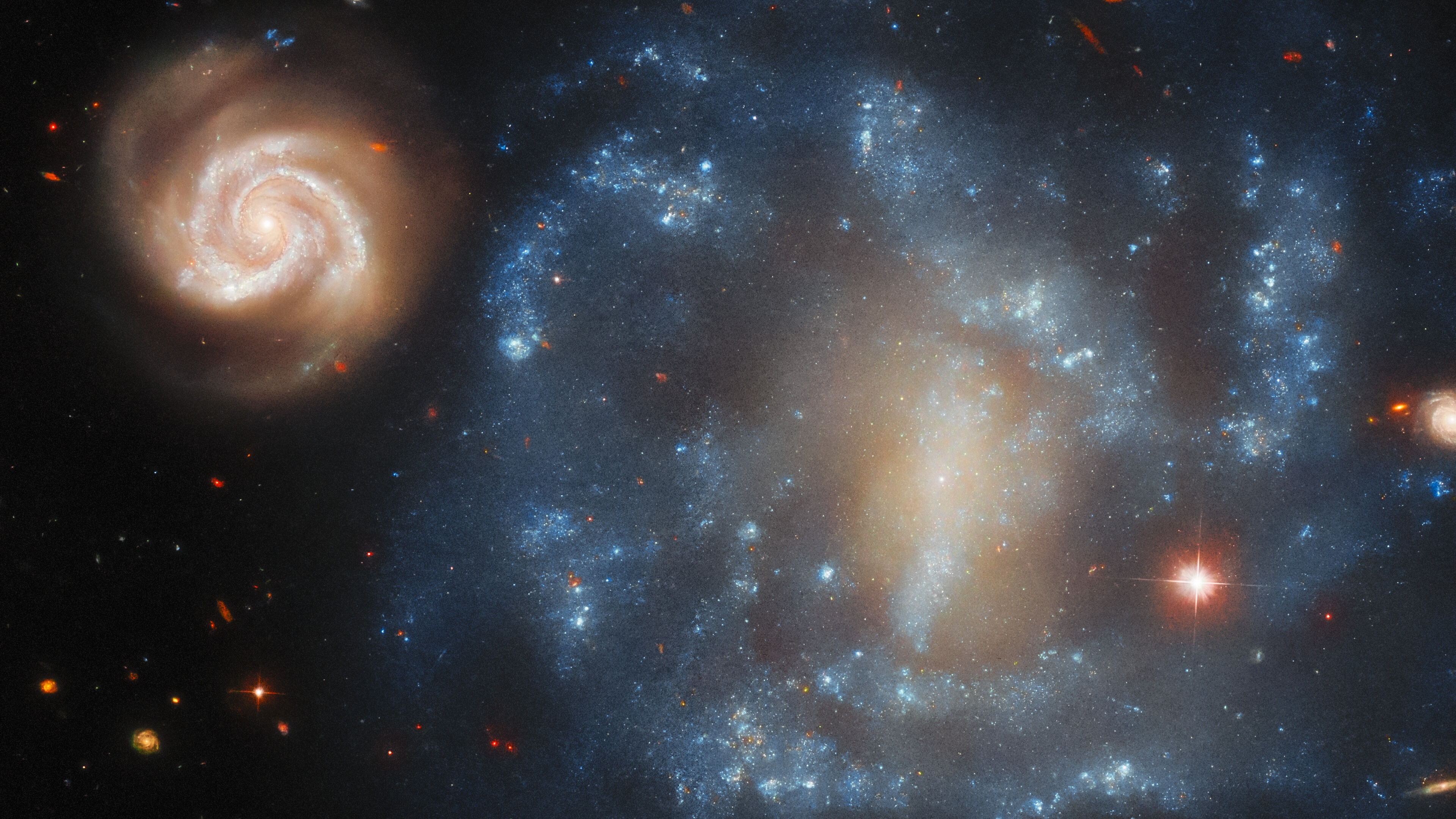
These galaxies look to be close companions — a small, bright spiral galaxy flitting around the edge of a much larger spiral with a dark and disturbed countenance. But looks can be deceiving — how close are they really? The celestial pair featured in this week’s Hubble Picture of the Week is known by the name Arp 4, and lies in the constellation Cetus (the Whale).
The designation Arp 4 comes from the Atlas of Peculiar Galaxies, compiled in the 1960s by astronomer Halton Arp. “Unusual galaxies” were selected and photographed to provide examples of weird and non-standard shapes, the better to study how galaxies evolve into these forms. Throughout its mission the Hubble Space Telescope has revolutionised the study of galaxies and shown us some fantastically unusual examples from Arp’s atlas. In that catalogue, the first few galaxies like Arp 4 are “low surface brightness” galaxies, a type of galaxy that is unexpectedly faint and hard to detect. The large galaxy here — also catalogued as MCG-02-05-050 — fits this description well, with its fragmentary arms and dim disc. Its smaller companion, MCG-02-05-050a, is a much more bright and active spiral.
The trick is that these galaxies are not actually very close. The large blue galaxy MCG-02-05-050 is located 65 million light-years from Earth; its brighter smaller companion MCG-02-05-050a, at 675 million light-years away, is over ten times the distance! Owing to this, MCG-02-05-050a is likely the larger galaxy of the two, and MCG-02-05-050 comparatively small. Their pairing in this image is simply an unlikely visual coincidence. Despite this lack of a physical relation between them, our point of view on Earth allows us to enjoy the sight of Arp 4 as an odd couple in the sky.
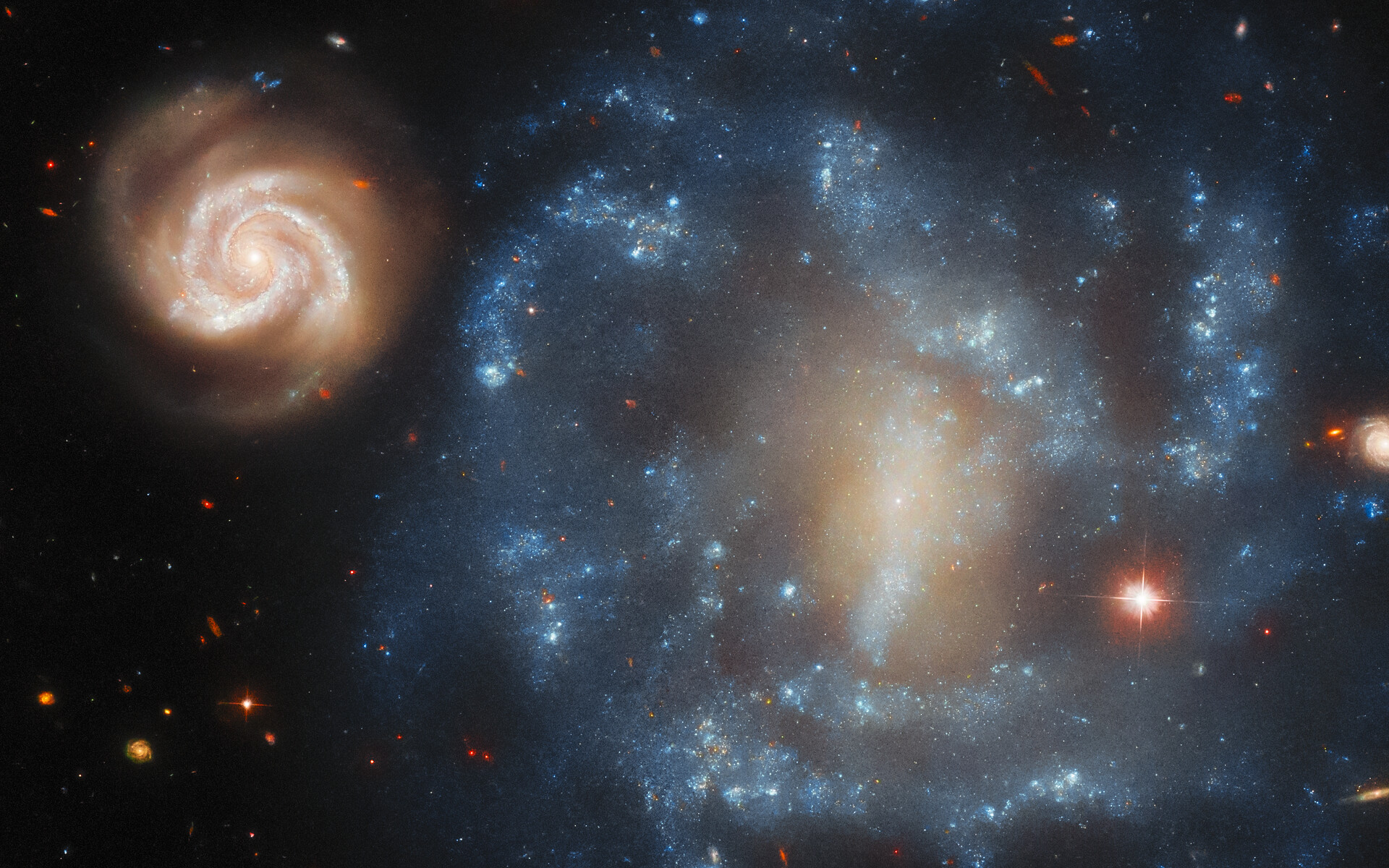
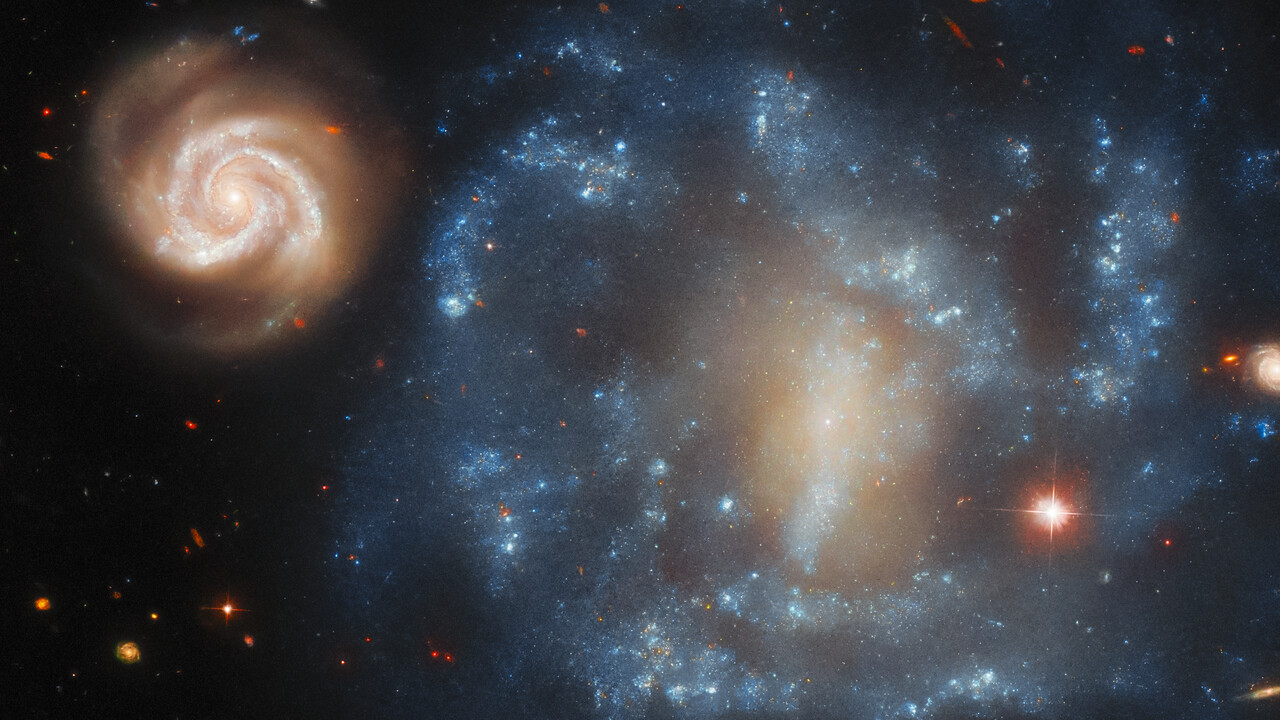
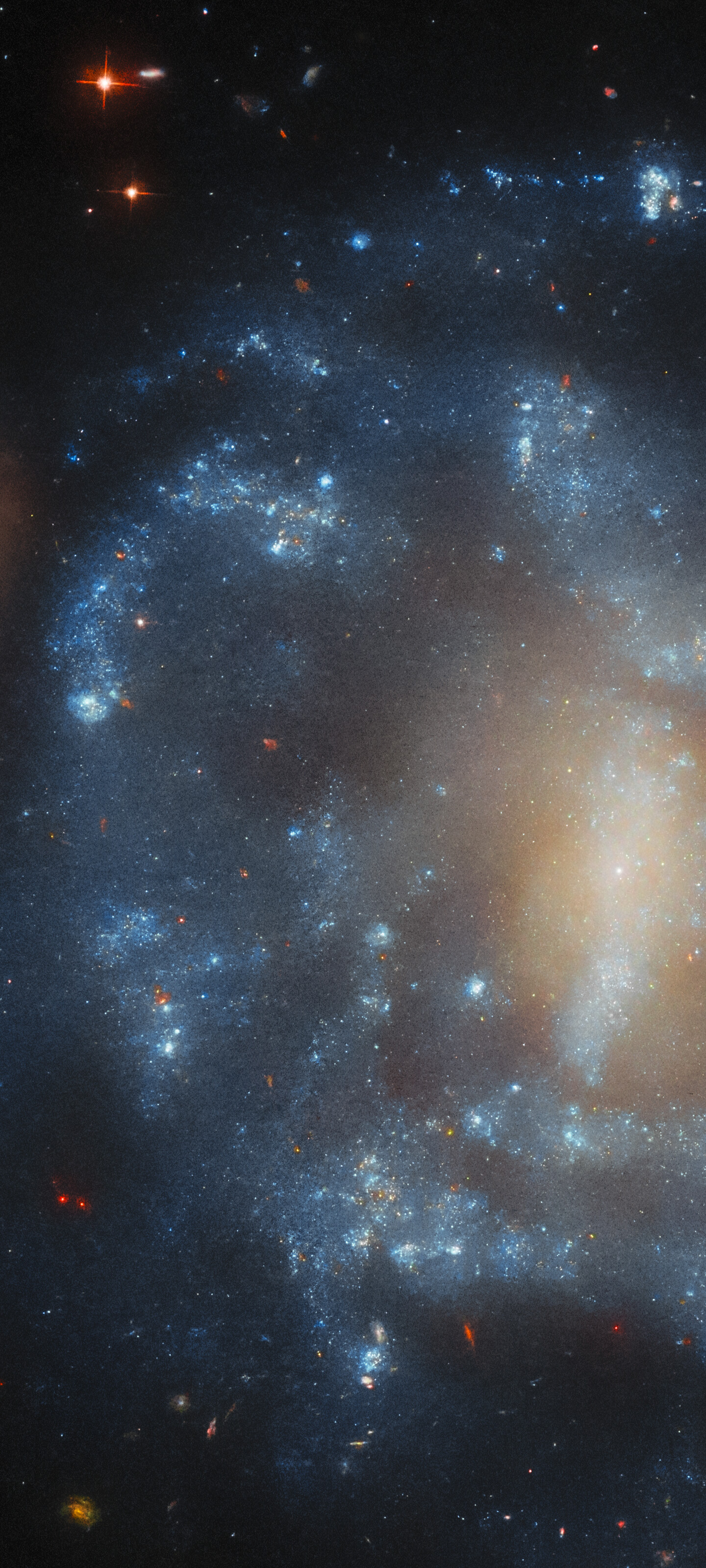
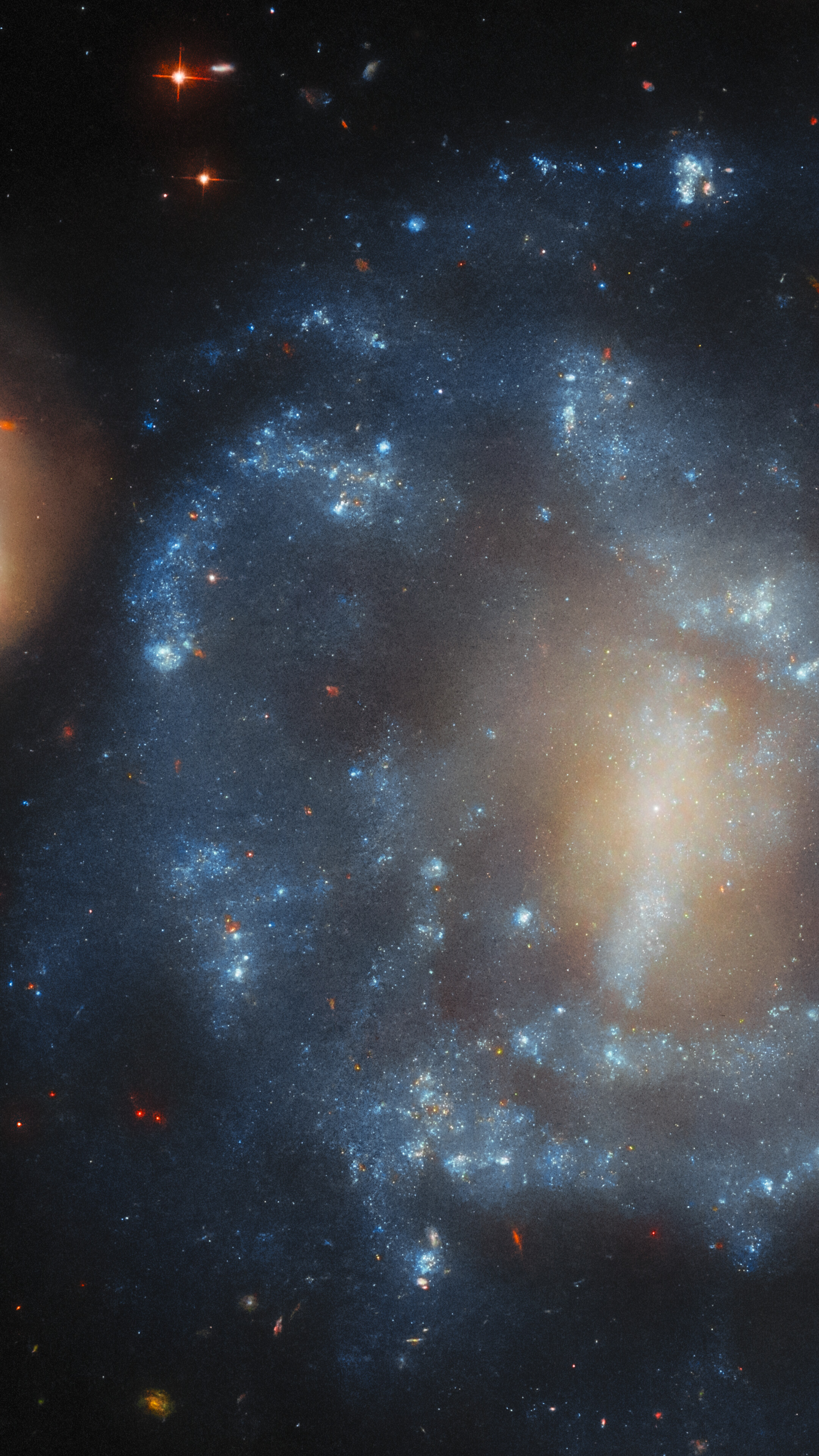
[Image Description: This image shows two galaxies side by side. The galaxy on the top left is smaller in size, and appears as a bright glowing spiral with clearly-defined arms. A larger blue galaxy dominates the full right field of the image. This galaxy is more irregularly shaped, with a glowing central bar, and varying regions of concentrated hues of blue. The background is black with various stars and galaxies in the distance.]
Links
Credit:ESA/Hubble & NASA, J. Dalcanton, Dark Energy Survey/DOE/FNAL/DECam/CTIO/NOIRLab/NSF/AURA
About the Image
| Id: | potw2551a |
|---|---|
| Type: | Observation |
| Release date: | 22 December 2025, 06:00 |
| Size: | 3845 x 3330 px |
About the Object
| Name: | Arp 4 |
|---|---|
| Distance: | 65 million light years |
| Constellation: | Cetus |
| Category: | Galaxies |


Classic Wallpapers

Desktop Wallpapers
Mobile Wallpapers


Coordinates
| Position (RA): | 1 48 27.73 |
|---|---|
| Position (Dec): | -12° 23' 1.26" |
| Field of view: | 3.20 x 2.77 arcminutes |
| Orientation: | North is 34.2° right of vertical |

Colours & filters
| Band | Wavelength | Telescope |
|---|---|---|
| Optical g | 473 nm | Víctor M. Blanco 4-meter Telescope DECam |
| Optical r | 642 nm | Víctor M. Blanco 4-meter Telescope DECam |
| Optical z | 926 nm | Víctor M. Blanco 4-meter Telescope DECam |
| Optical V | 606 nm |
Hubble Space Telescope
ACS |