heic2602 — Science Release
Hubble uncovers the secret of stars that defy ageing
21 January 2026
Some stars appear to defy time itself. Nestled within ancient star clusters, they shine bluer and brighter than their neighbours, looking far younger than their true age. Known as blue straggler stars, these stellar oddities have puzzled astronomers for more than 70 years. Now, new results using the NASA/ESA Hubble Space Telescope are finally revealing how these “forever young” stars come to be and why they thrive in quieter cosmic neighbourhoods.
Blue straggler stars stand out in old star clusters because they appear hotter, more massive and younger than stars that should all have formed billions of years ago. Their very existence contradicts standard theories of stellar ageing, prompting decades of debate over whether they are created through violent stellar collisions or through more subtle interactions between pairs of stars. A new study provides some of the clearest evidence yet that blue stragglers owe their youthful appearance not to collisions, but to life in close stellar partnerships, and to the environments that allow those partnerships to survive.
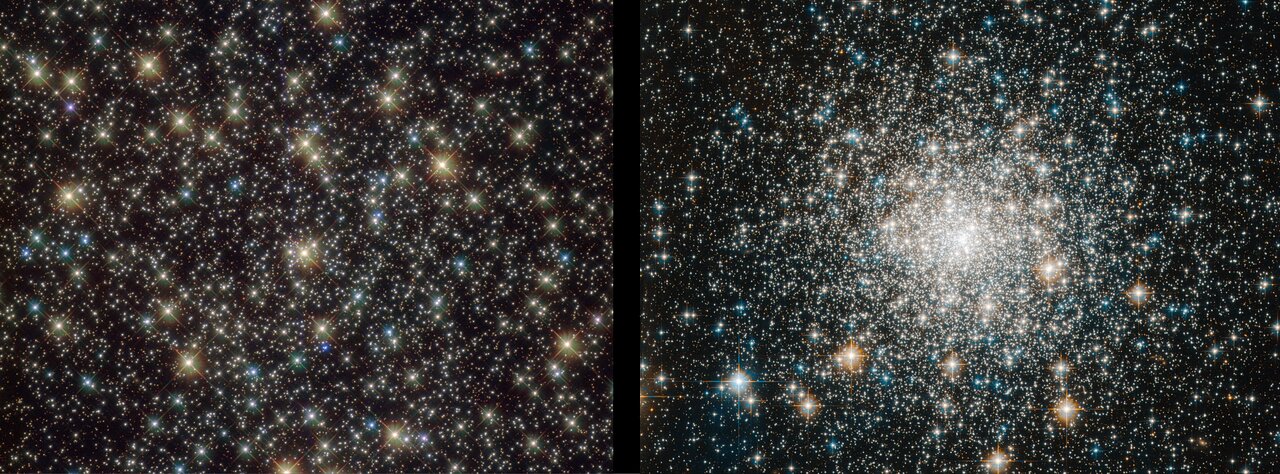
An international research team analysed ultraviolet Hubble observations of 48 globular clusters in the Milky Way, assembling the largest and most complete catalogue of blue straggler stars ever produced. The sample includes more than 3000 of these enigmatic objects. Their host clusters span the entire range of possible environmental conditions, from very loose to very dense systems (as illustrated in Image A). This vast dataset allowed astronomers to investigate the long-suspected links between blue straggler stars and their surroundings.
Rather than finding more blue stragglers in the most crowded, collision-prone clusters, the team was surprised to discover the opposite: dense environments host fewer blue stragglers. Instead, these stars are most common in low-density clusters, where stars have more space and where fragile binary systems are more likely to survive.
“This work shows that the environment plays a relevant role in the life of stars,” says Francesco R. Ferraro, lead author of the study and professor at the University of Bologna in Italy. “Blue straggler stars are intimately connected to the evolution of binary systems, but their survival depends on the conditions in which they live. Low-density environments provide the best habitat for binaries and their by-products, allowing some stars to appear younger than expected.”
The team found that blue stragglers are closely linked to binary star systems, in which two stars orbit one another. In such systems, one star can siphon material from its partner or merge with it entirely, gaining fresh fuel and shining more brightly and blue (effectively resetting its stellar clock).
However, these observations show that denser environments host less binaries, suggesting that in densely packed clusters, frequent close encounters between stars can break binaries apart before they have time to produce a blue straggler. In calmer environments, binaries survive and blue stragglers flourish.
“Crowded star clusters are not a friendly place for stellar partnerships,” explains Enrico Vesperini from Indiana University in the United States. “Where space is tight, binaries can be more easily destroyed, and the stars lose their chance to stay young.”
This discovery marks the first time that such clear and opposite-to-expectation relationships have been observed between blue straggler populations and their environments. It confirms that blue stragglers are a direct by-product of binary evolution and highlights how strongly a star’s surroundings can influence its life story.
“This work gives us a new way to understand how stars evolve over billions of years,” said Barbara Lanzoni, co-author of the study from the University of Bologna in Italy. “It shows that even star lives are shaped by their environment, much like living systems on Earth.”
By resolving individual stars in crowded clusters and observing them in ultraviolet light, Hubble was uniquely suited to uncovering this long-hidden pattern. The findings not only solve a long-standing astronomical mystery, but also open new paths for understanding how stars interact, age and sometimes find ways to start anew.
These results have been published today in Nature Communications.
More information
The Hubble Space Telescope is a project of international cooperation between ESA and NASA.
Image Credit: ESA/Hubble & NASA
Links
Contacts
Bethany Downer
ESA/Hubble Chief Science Communications Officer
Email: [email protected]
About the Release
| Release No.: | heic2602 |
|---|