sci25008 — Announcement
Highlights from ESA/Hubble and ESA/Webb in 2025
17 December 2025
- By Owen Higgins -
2025 was another busy year for us in the ESA/Hubble/Webb science outreach team.
Webb has had another highly productive year of science operations, resulting in many new insights that we have been able to share with the public — too many to fully list here!
A particular highlight this year was some fascinating new views of magnetic activity on Solar System planets: scientists were able to capture the auroral activity on Neptune for the first time, while on the magnetically-active Jupiter, astronomers observed the aurorae over several hours with Webb and watched the auroral region change in real time.
Webb also made great progress this year in observing worlds beyond our Solar System. In the Alpha Centauri system — a Sun-like star just 4 light-years away — astronomers found strong evidence of a giant planet, while Webb’s first direct image discovery of an exoplanet came with a Saturn-like planet in the debris disc around the young star TWA 7. With direct imaging of exoplanets in the HR 8799 system, researchers detected carbon dioxide in their atmospheres, giving evidence of how they were formed. And astronomers studied the atmosphere of Earth-sized exoplanet TRAPPIST-1 d using Webb’s sensitive instruments, ruling it out as similar to our own atmosphere. Further from home, new discoveries this year included a galaxy mysteriously clearing the fog of the early Universe just 330 million years after the Big Bang, and a potential hidden supermassive black hole in nearby galaxy M83.
Unprecedented images of cosmic vistas are a hallmark of Webb’s activities since the start of science operations, and this year was no different. Webb’s view of the rich galaxy cluster Abell S1063 afforded us a glimpse of the distant past, and the chance alignment of a spiral and elliptical galaxy created a spectacular and clear Einstein ring. Eight other stunning examples of gravitational lenses came from a search through a Webb survey of distant galaxies. Star-forming systems featured heavily with photos of colourful nebulae, from the shining celestial mountaintop of Pismis 24 to the Cat’s Paw Nebula — subject of Webb’s third anniversary image! A planet-forming disc created colourful, gossamer wisps around protostar IRAS 04302+2247, while Webb also caught unprecedented details in the creepy-crawly Red Spider Nebula. With contributions from the Hubble Space Telescope and the Atacama Large Millimeter/submillimeter Array, Webb revealed new details too in the core of the Butterfly Nebula.
With its unique ultraviolet and visible capabilities, Hubble has also continued to excite and surprise us throughout the year with new views of the cosmos. The vaunted future collision of our Milky Way Galaxy and the Andromeda Galaxy was put in doubt by simulations using the newest data from Hubble and ESA’s Gaia. With its ultraviolet vision, Hubble spotted a Pluto-like object being eaten by a white dwarf star, as well as the rare remnant of a white dwarf merger. And not to forget, Hubble made possible a prompt reaction to the discovery of interstellar comet 3I/ATLAS, providing some of the first images in August along with estimates of its size.
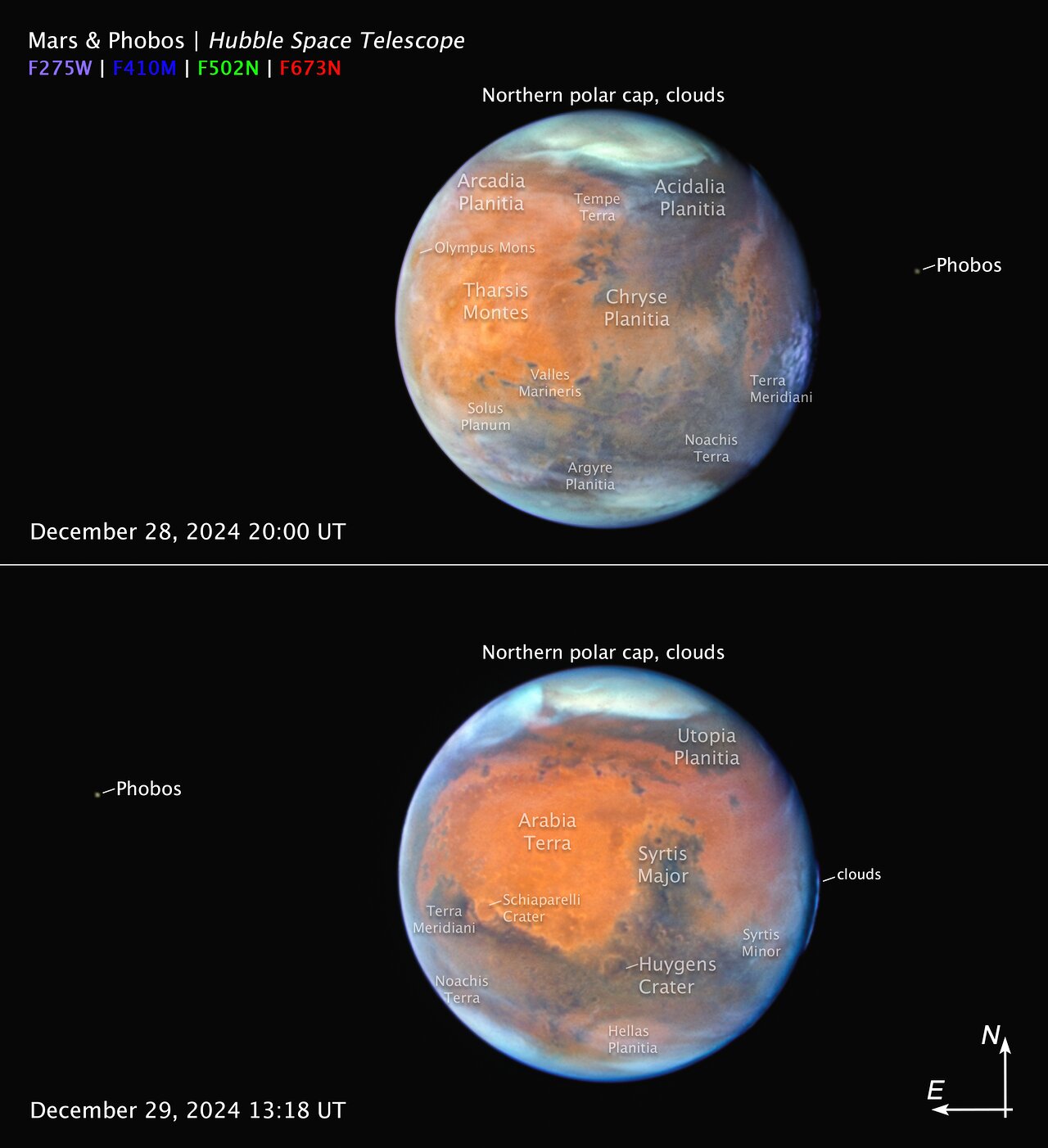
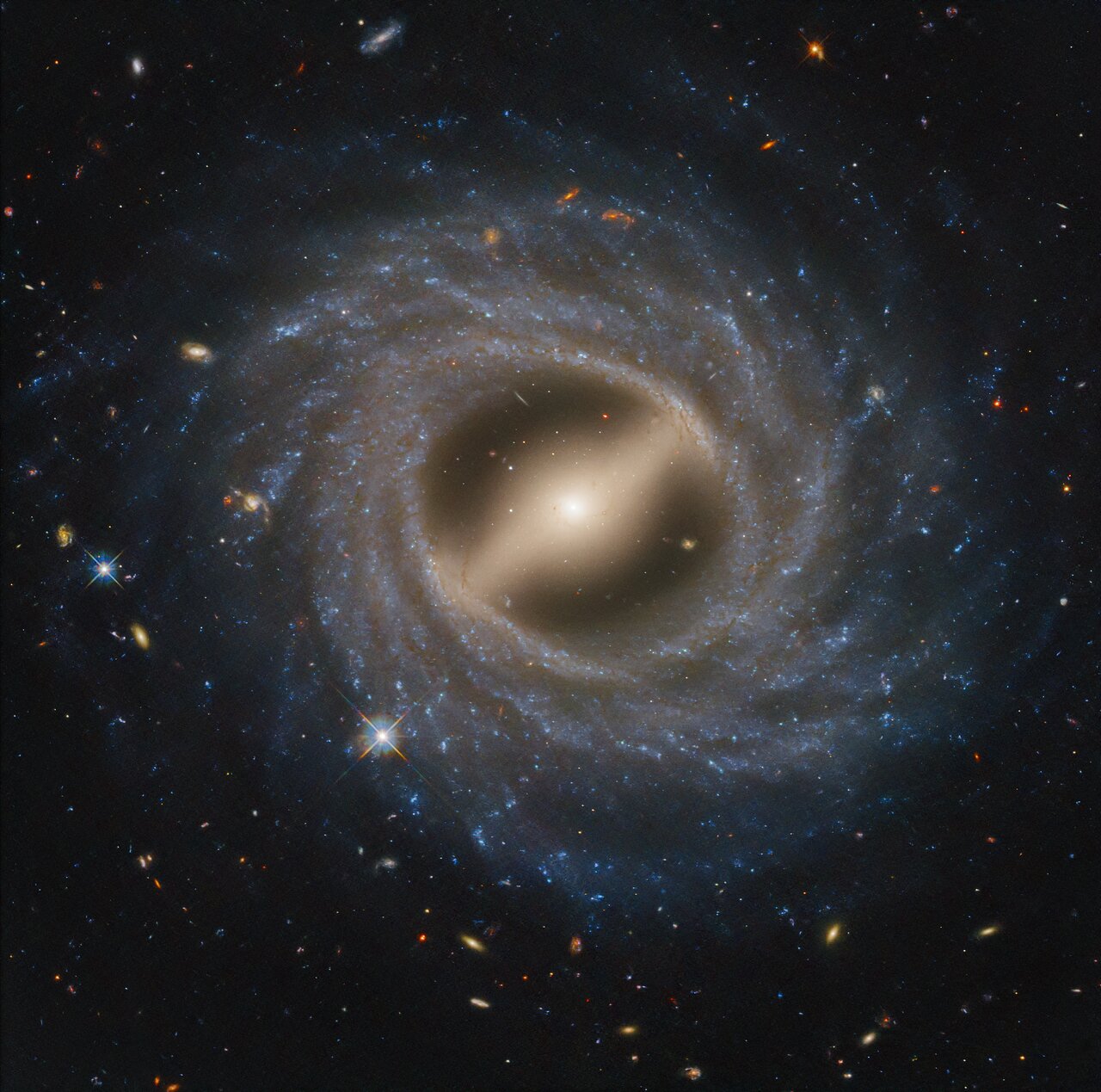
We had the very exciting celebrations of Hubble’s 35th anniversary this April, an incredible milestone for the observatory and the teams behind it. No better an occasion than that for some marvellous new image releases! In the lead-up to the date itself, ESA/Hubble released several fresh takes on previous Hubble images: stellar sculptors at work in the Small Magellanic Cloud, imposing towers of stardust in the Eagle Nebula, and a galactic favourite among the public, the Sombrero Galaxy. Finally we were treated to not one, but four brand new images for Hubble’s 35th birthday! These were the nebula NGC 2899 and the Rosette Nebula, barred spiral galaxy NGC 5335, and new views of the Red Planet. The images were showcased and shared with the public at events held across Europe.
Looking ahead to ESA/Webb’s and ESA/Hubble’s activities in 2026, we will continue to emphasise the role of ESA and the European astronomical community in the telescopes’ continued success, and the use of Hubble and Webb data by European institutions and scientists. ESA/Hubble and ESA/Webb can help scientists by producing and distributing press releases, image processing, web articles, artists’ impressions, and high-definition videos — like the 2025 release highlights mentioned above. If you think any aspect of your research could be of interest to the public at large, or your observations might produce an image suitable for public release, please get in touch with us as early as possible so we can explore possible avenues for promoting your work!
In the meantime, we encourage you to follow the ESA/Hubble and ESA/Webb social media channels to keep up with the latest updates about how European scientists and engineers are contributing to this mission. As always, we encourage you to reach out if you have any questions or ideas you’d like to discuss!
Contacts
Bethany Downer
ESA/Webb & ESA/Hubble Chief Science Communications Officer
E-mail: [email protected]