NICMOS finds a golden ring at the heart of a galaxy (NICMOS image)

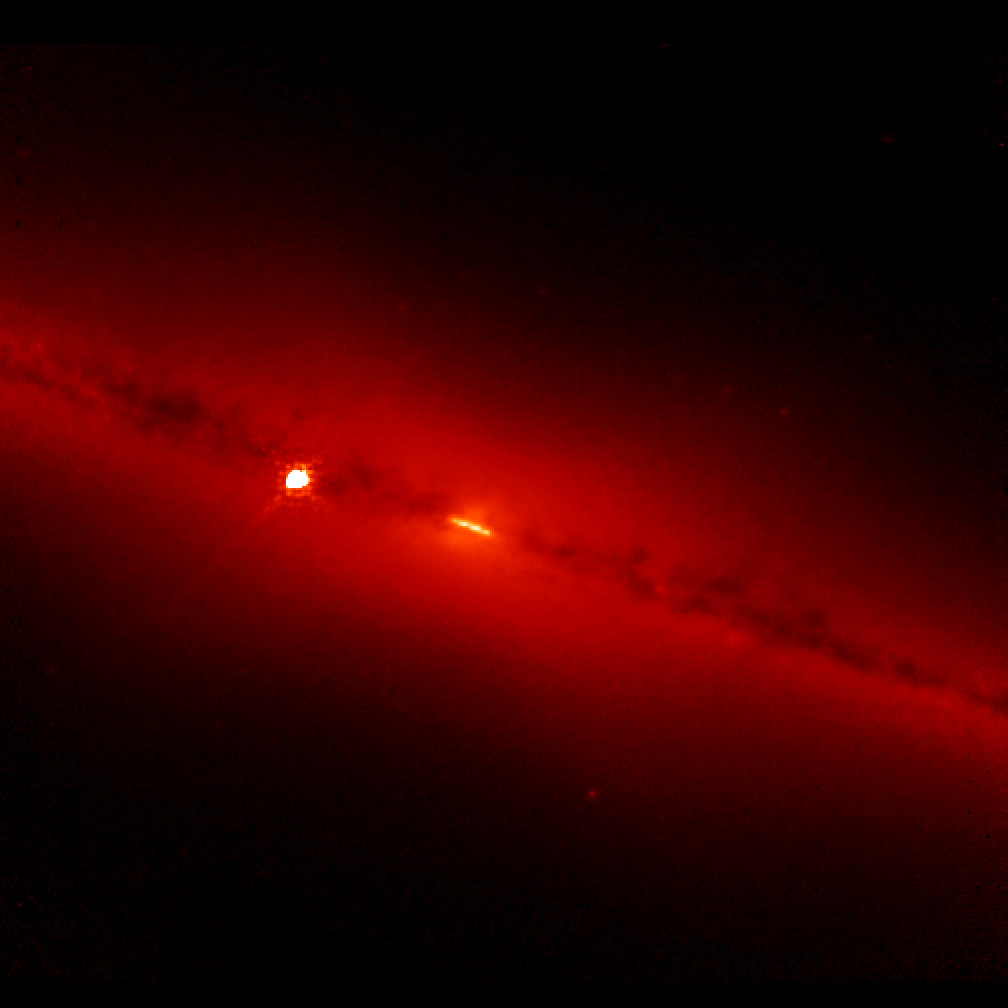
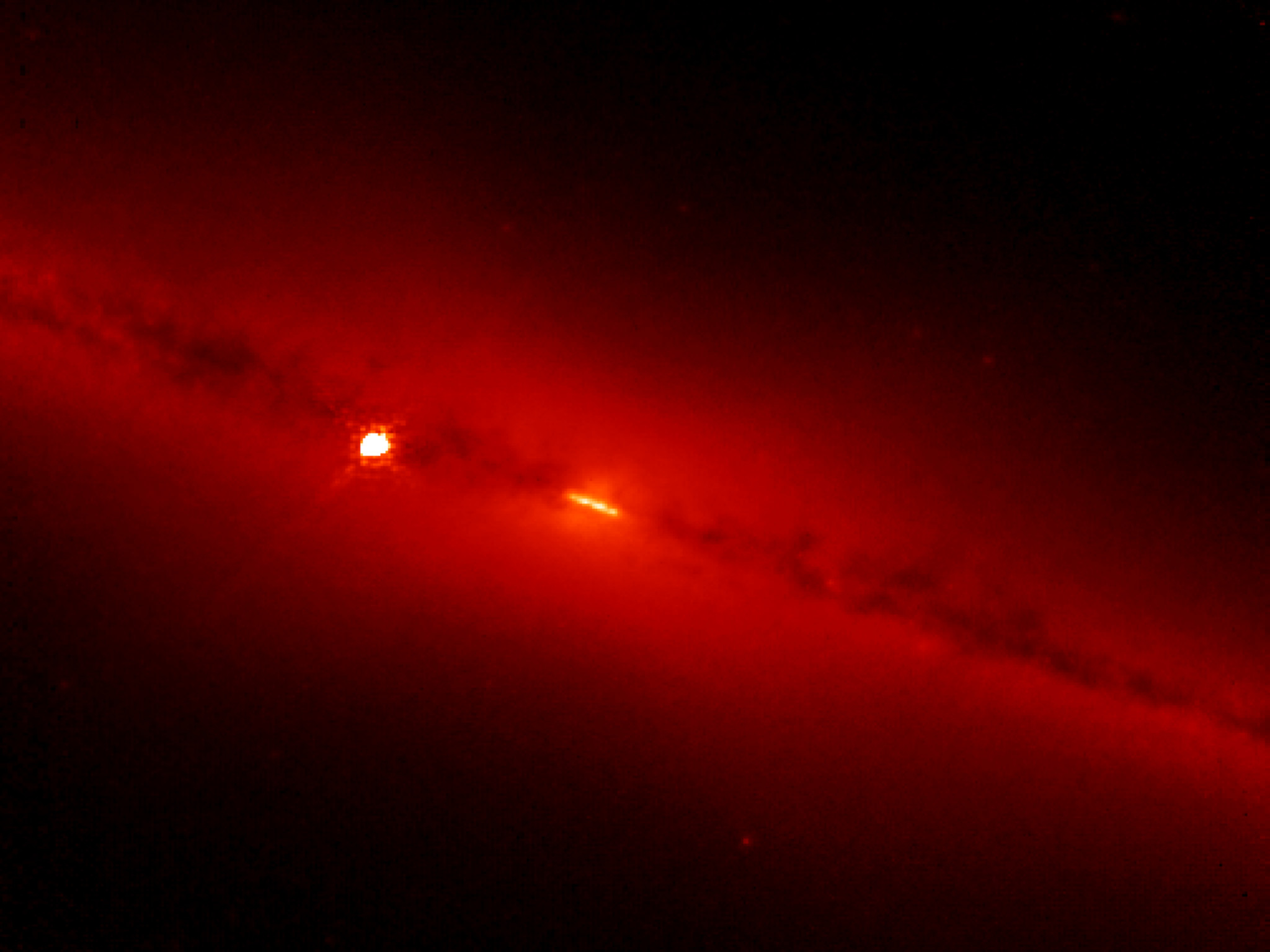
The revived Near Infrared Camera and Multi-Object Spectrometer (NICMOS) aboard the NASA/ESA Hubble telescope has penetrated the dusty disc of the 'edge-on' galaxy NGC 4013 and looked right into the galactic core. To the surprise of astronomers, NICMOS found a brilliant band-like structure, that may be a ring of newly formed stars seen edge-on.
NICMOS enables the Hubble telescope to see near-infrared wavelengths of light, so that it can penetrate the dust that obscures the inner hub of the galaxy. The ring-like structure seen by NICMOS encircles the core and is about 720 light-years wide, which is the typical size of most star-forming rings found in disc galaxies.
The human eye cannot see infrared light so colours have been assigned to correspond to near-infrared wavelengths. The blue light represents shorter near-infrared wavelengths and the red light corresponds to longer wavelengths.
This picture, taken with a filter sensitive to hydrogen, shows the glow of stars and gas. Astronomers used this information to calculate the rate of star formation in the ring-like structure.
NGC 4013, which looks similar to our Milky Way Galaxy, resides in the constellation Ursa Major, 55 million light-years from Earth.
This image, obtained on 12 May 2002, was taken through the Paschen-alpha filter.
Credit:About the Image
| Id: | heic0207g |
|---|---|
| Type: | Observation |
| Release date: | 5 June 2002, 15:00 |
| Related releases: | heic0207 |
| Size: | 1008 x 1008 px |
About the Object
| Name: | IRAS 11559+4413, NGC 4013 |
|---|---|
| Type: | Local Universe : Galaxy : Type : Spiral |
| Distance: | 60 million light years |
| Constellation: | Ursa Major |
| Category: | Galaxies |

Classic Wallpapers


Coordinates
| Position (RA): | 11 58 31.17 |
|---|---|
| Position (Dec): | 43° 56' 51.65" |
| Field of view: | 0.85 x 0.85 arcminutes |
| Orientation: | North is 5.7° left of vertical |

Colours & filters
| Band | Wavelength | Telescope |
|---|---|---|
| Infrared Pa-alpha | 1.87 μm |
Hubble Space Telescope
NICMOS |