ann2503 — Announcement
Announcement of the 2026 ESA Hubble and Webb Calendar
17 December 2025
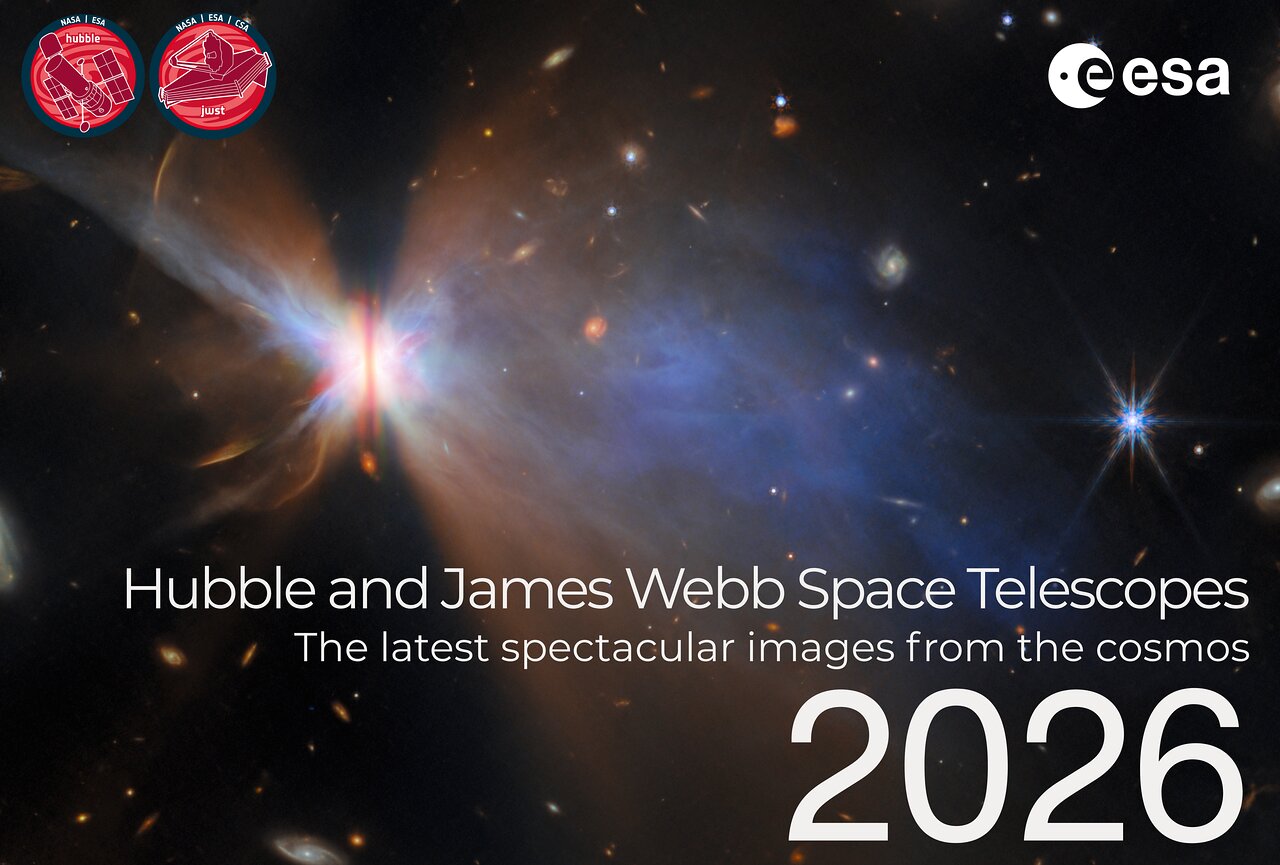
To celebrate another year of exciting images and discoveries from the NASA/ESA Hubble Space Telescope and the NASA/ESA/CSA James Webb Space Telescope, ESA/Hubble and ESA/Webb have released a new calendar for 2026 that showcases beautiful imagery from both missions.
The 2026 calendar features a selection of images from Press Releases (from Hubble and Webb), Hubble Pictures of the Week and Webb Pictures of the Month published throughout 2025. These include imagery of planets, star clusters, galaxies, and more. It can now be accessed electronically for anyone to print, share and enjoy (please see the links provided below).
The images featured in the calendar are as follows:
Cover: IRAS 04302+2247 is a planet-forming disc located about 525 light-years away in a dark cloud within the Taurus star-forming region. This beautiful Webb image shows an example of a protostar (a young star that is still gathering mass from its environment) surrounded by a protoplanetary disc in which baby planets might be forming.
January:.As part of Hubble’s 35th anniversary celebrations, ESA/Hubble published a new image of the star cluster NGC 346, featuring new data and processing techniques. This prolific star factory is in the Small Magellanic Cloud, one of the largest of the Milky Way’s satellite galaxies.
February: This image from Webb features a mega-monster galaxy cluster known as Abell S1063, lying 4.5 billion light-years from Earth in the constellation Grus. The dense collection of heavy galaxies is surrounded by glowing streaks of light, and these warped arcs demonstrate gravitational lensing.
March: To celebrate Webb’s third year of highly productive science in July 2025, astronomers used the telescope to scratch beyond the surface of the Cat’s Paw Nebula (NGC 6334), a massive, local star-forming region.
April: ESA/Hubble revisited the star cluster Messier 72 in April 2025 to celebrate Hubble’s 35th anniversary with new data and image processing techniques. This is a particularly special target because it was the first image ever published in the ESA/Hubble Picture of the Week series in April of 2010.
May: In these Webb images taken in December 2023, our Solar System’s largest planet shows off new details in its auroras (shown in the left image), which are hundreds of times brighter than those seen on Earth.
June: Called Pismis 24, this young star cluster resides in the core of the nearby Lobster Nebula, approximately 5,500 light-years from Earth in the constellation Scorpius. Home to a vibrant stellar nursery and one of the closest sites of massive star birth, Webb provides us with rare insights into large and massive stars.
July: Located around 30 million light-years away in the constellation Virgo, this Hubble image features the Sombrero Galaxy. Viewed nearly edge on, the galaxy’s softly luminous bulge and sharply outlined disc resemble the rounded crown and broad brim of the Mexican hat from which the galaxy gets its name.
August: This image set showcases three views of the Butterfly Nebula, also called NGC 6302. The first and second of the three images shown feature the nebula in optical and near-infrared light captured by Hubble. The Webb image on the right zooms in on the object’s centre.
September: This image was shared by ESA/Hubble as part of Hubble’s 35th anniversary celebrations and incorporates new data processing techniques. It shows a small portion of the Eagle Nebula that is 9.5 light-years long and 7,000 light-years away from Earth. This vast stellar nursery displays a towering spire of cosmic gas and dust.
October: Hubble captures in exquisite detail a face-on view of the remarkable-looking galaxy NGC 5335 in this image. This is a flocculent spiral galaxy with patchy streamers of star formation across its disc. A notable bar structure slices across the center of the galaxy.
November: This image shows Webb’s view of the planetary nebula NGC 6072 in the near-infrared. It highlights a complex scene of multiple outflows expanding out at different angles from a dying star at the centre of the scene. These outflows push gas toward the equatorial plane, forming a disc.
December:A beautiful but skewed spiral galaxy dazzles in this Hubble image. This galaxy, called Arp 184 or NGC 1961, sits about 190 million light-years away from Earth in the constellation Camelopardalis (The Giraffe).
Back Page: This Hubble image captures incredible details in the dusty clouds in the outskirts of a star-forming region called the Tarantula Nebula in the Large Magellanic Cloud, a dwarf galaxy that is located about 160 000 light-years away in the constellations Dorado and Mensa. The Large Magellanic Cloud is the largest of the dozens of small satellite galaxies that orbit the Milky Way.
Please note that hard copies are not available directly from ESA/Hubble/Webb. We invite you to avail yourself of the free calendar formats below.
Links
- Print-Ready 2026 Calendar File
- High Resolution Digital 2026 Calendar File
- Low Resolution Digital 2026 Calendar File
- 2025 ESA/Hubble 35th Anniversary Calendar
- 2025 ESA/Hubble/Webb 2025 Calendar
- 2024 ESA/Hubble/Webb Calendar
- 2023 ESA/Hubble/Webb Calendar
- 2022 ESA/Hubble Calendar
- 2021 ESA/Hubble Calendar
- 2020 ESA/Hubble Calendar
Contacts
Bethany Downer
ESA/Webb & ESA/Hubble Chief Science Communications Officer
E-mail: [email protected]
About the Announcement
| Id: | ann2503 |
|---|